
Gold at the Kola Superdeep Borehole: why was the project closed?
The Korah super-deep drilling project was a large-scale geological drilling project carried out by the Soviet Union during the cold war. The historical background was the 1960s, when the United States took the lead in making a manned landing on the moon, leaving the Soviet Union in the aerospace field. The Soviet side is naturally going to have to fight back to one game. The ultra-deep drilling work was therefore selected in the Kola peninsula in order to be able to exceed the United States in the field of underground engineering.
After the end of World War II, the world moved from the fascist and anti-fascist camps to the American-led capitalist and Soviet-led socialist camps. In addition to this, many countries have opted not to associate, but are unable to remain outside the world landscape of two rivalrys. The United States and the Soviet Union have launched a global and comprehensive competition in various fields. The two most important areas are military and scientific.
The Soviet Union and the United States were in the dark since the 1950s. Neither side is willing to lag behind each other in the aerospace field. The Soviet Union was originally leading the United States in human space. First to send people into outer space. This is the first astronaut to enter space in human history, Gagarin. However, the United States quickly countered the Soviet Union in the aerospace field after the Apollo Moon plan was developed in the 1960s. The project has been launched and is being carried out.
Thus, after the Soviet Union had failed in space, the focus of development had shifted to underground engineering. The Kola peninsula, which is located near the Arctic Circle, has thus become the site of the Soviet Union for underground drilling work. The plan was named Cora Super Deep Drilling Project. The initial plan is to drill 15 kilometres.
The Cora super-deep drilling project began in 1970 and reached 12,000 metres in 1983. It seems that the target is not far away. However, from 1983 to 1994, the drilling depth was only 263 metres down. And the cost is several times higher. It’s because it’s going to be deep. The difficulty of drilling is exponential, and the drill is often damaged by high temperatures. The maintenance of equipment and the removal of drilling bore a heavy toll on the pace of drilling. The project was then forced to terminate with the dissolution of the Soviet Union.
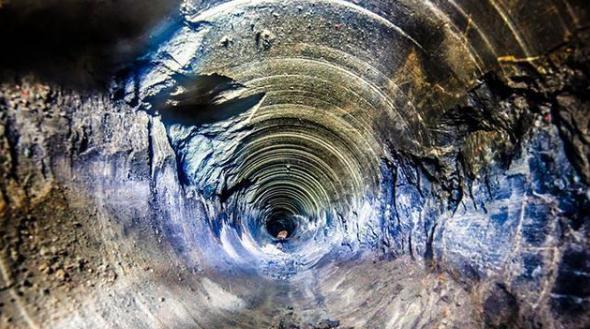
The Korah super-deep drilling project was not without its worth, and the Soviet Union had established more than a dozen scientific laboratories near the Korah peninsula super-deep drilling project. Scientific research is carried out on the drilling of the drills extracted from within the rigs. It has made a significant contribution to human understanding of the distribution and geological structure of the subsurface.
It is also worth noting that the levels of gold and diamonds are extremely high at a depth of about 9,500 metres from the ground. The gold and diamonds found at this depth are higher than the gold mine on the surface. That means that the gold does have high commercial value. But to this day, human science and technology are still unable to exploit this depth of gold commercially. Again, the reason why neither the former Soviet Union nor Russia today exploited it.